
Fatal Fury 2 story
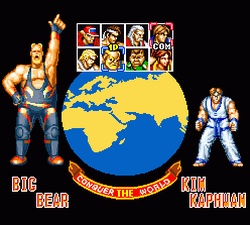
Fatal Fury 2 has that rare kind of magic where calling it a “legend” isn’t just marketing. In the arcades it went by Garou Densetsu 2 — Legend of the Hungry Wolf: The New Battle; around here it stuck as Fatal Fury 2, while some stubbornly called it “Deadly Fury.” Whatever the name, it was a story you wanted to live through again: Terry Bogard’s red cap, King of Fighters flyers everywhere, a soundtrack that made you square up even from the couch. Most of all, it felt like fighting wasn’t just punches—it was personalities, cities, faces, and miles of road.
How the “new battle” was born
By then SNK had found the series’ voice: not brawl-for-brawl’s sake, but a travelogue of rivalry. After Geese Howard’s fall, South Town’s legend went global, and another aristocrat of the fist—Wolfgang Krauser—stepped into the light. He set up a new tournament to test the rumors about the “wolf” from America. The plot works like a map: from neon streets to Spanish bullrings, from an eastern bazaar to a brooding European castle—every stage feels like a postcard from the road. That’s why the sequel resonated: it broadened the universe, made it distinct and almost tangible.
SNK took the Garou Densetsu core and added what players asked for: more fighters, more personality, more reasons to jaw by the cab about who’s carrying today. Alongside Terry, Andy, and Joe Higashi came new stars—Mai Shiranui, whose speed and smile hit the posters immediately; the steel discipline of Kim Kaphwan; old judo master Jubei Yamada; heavyweight Cheng Sinzan; and a heel-turned-face wrestler, Big Bear. Waiting in the wings were the bosses—Billy Kane with his staff, bruiser boxer Axel Hawk, matador Lawrence Blood, and Krauser himself. A roster that felt like history, not just a list of sprites.
From arcade to home
Arcade floors packed around Fatal Fury 2: quarters clinked like a round counter, and the music rolled in—sharp as a slap on the ring ropes, then ceremonial as the camera climbed to the final boss’s keep. But the real affection bloomed at home. The Super Nintendo port brought that arcade swagger over to the couch—tea on the table, a stubborn “one more round.” For many, this was the 16-bit fighter: the start of living-room grudge matches, two-player brackets, talk about “combos” and “specials,” about landing a Power Wave a step from victory or slipping to the back line at just the right beat.
The series’ dual-plane arenas—its calling card—felt simple in practice: step back to survive, step in to punish. Not some dry mechanic, but part of the story: you’re crossing the world throwing down, while you’re really learning to read a rival, to sync with their tempo like in a real tournament. That’s how Fatal Fury 2 became a journey, not just a checklist of stages.
Why people fall for it
Faces and places. That’s where the bond comes from. Terry with his eternal “OK!” and the Fatal Fury cap feels like a brother; Mai is a breeze of freedom and a sly grin; Kim is honor in motion; Joe is the loud buddy always ready to spin up a whirlwind. Even the antagonists stick in your head: Billy is a South Town backstreet at night, Lawrence is the smell of the ring and a red cape, Axel is sweat and the roar of the crowd. Krauser isn’t just “the final,” he’s the breath the orchestra takes before the last round.
The game spread fast and stuck around. Some places remember it by arcade cabs, others by SNES carts and cool evenings when neighbors dropped by “for a match.” Phrases like “King of Fighters,” “Legend of the Hungry Wolf,” “Garou Densetsu” wove into our vocabulary by themselves: some said it in Japanese, some in English, some in their own tongue—but everyone meant the same feeling: a fair duel where it’s not only about buttons, but about grit and that grin before a do-or-die jump.
Strangely enough, even the “utility” stuff—codes, secrets, theories on how to unlock the bosses—became part of the shared myth. Someone swore they heard a special chord on Krauser’s stage, someone else argued which track in the soundtrack hit hardest. But the main thing was meeting at the TV. On the carpet, on a stool, gamepad in hand, we traced the tournament route again: South Town, Spain, China, Australia, Germany… and the final climb up stone steps where every mistake costs too much.
And so Fatal Fury 2—Garou Densetsu 2, Deadly Fury 2, Legend of the Hungry Wolf: The New Battle—stuck not as just another port, but as a warm chapter in our gaming biography. There was room for arcade bravado, homey comfort, and that shoulder-to-shoulder feeling when your friend’s second pad is already part of your shared story. Every time the familiar round countdown kicks in, it feels like more than a fight—it’s one more little road worth traveling together.