
Fatal Fury 2 Gameplay
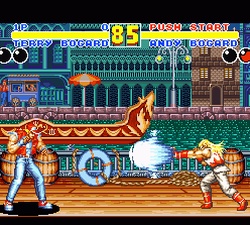
In Fatal Fury 2, rhythm rules everything. The opening gong hits, and you’re already reading your rival’s breathing from the tiniest twitches, the little hesitations before a strike. Seconds bleed off the clock like sand, and every dash, every hop is a choice with the weight of a full round. Fatal Fury 2 doesn’t rush you—it persuades. Close the gap and bet it all on an uppercut? Back out, toss a fireball to blow up the spacing, catch your breath? In this fighter, a duel feels like blitz with a chess clock strapped to your wrist: the buttons are your pieces, and your nerves are the currency.
Two planes — one arena
The series’ calling card is fighting on two planes. Sounds like a gimmick, plays like a hidden door in the wall. Half a second ago you were squared up with Terry Bogard, ready to eat a Burn Knuckle; now you slip to the back plane and the punch whooshes past. Fatal Fury 2 teaches grown-up hide-and-seek: vanish, reappear, punish. Pressure, then a sudden sway into the other layer, and your opponent’s wind-up unravels—their back opens—and the punish flies. Every line shift is a change of tempo in the soundtrack: hit the beat and it carries you; miss it and a counter smacks you right in the face.
The sweetest moments come when you’re pinned at the edge. Instinct screams jump, but your hands do something smarter: slip to the background, take a microbeat, swing back with a check, and the crowd in the backdrop seems to exhale with you. A bite-sized escape sparks offense; offense creates pressure; pressure buys you a throw or baits a panicked burst. It’s not “just another mechanic”—it’s how the duel turns into a dance, full of feints and sharp pivots.
Moves with character, fighters with personality
Every fighter moves to a different tempo. Terry skims the floor with a creeping Power Wave, then crashes in shoulder-first—you can feel the screen lurch forward. Andy Bogard is craftier, all about sweeps and sneaky angles. Joe Higashi loves to loft whirlwinds and clip you as you land off-balance. Mai Shiranui dazzles with fan fireworks—her Kachosen floats in like a promise of trouble if you relax. Kim Kaphwan keeps immaculate form—straight, honest Taekwondo; blink and a lean diagonal kick snaps you across the shins.
The second plane really shines when the bosses arrive. Billy Kane’s bo staff cuts distance so clean you line shift just for the mental breather. Laurence Blood is a matador—blade and cape—dancing around you and making you stumble over nothing. Axel Hawk is a wall, swallowing space until you have to change planes or get jailed in the corner under jabs. But it’s all prelude. The true nerve check is Wolfgang Krauser, his thunderous step and a Kaiser Wave that cleaves the screen like an organ blast. When your lifebar is blinking red and that wave is already on its way, the world shrinks to two buttons and a single jump arc.
Timer, pressure, and the final seconds
The timer isn’t just numbers. It whispers “hurry up,” pushing you to gamble where you’d normally wait. Twenty seconds to go, and suddenly you stop playing “correct” because the other guy’s got a couple of pokes’ worth of life on you. That’s when the itch takes over: short hop with a toe tap, a plus jab to stay safe, one more step—and there it is, the last-gasp Desperation Move. In Fatal Fury 2 everyone’s got a finisher that unlocks near zero health—rare, finicky, oh-so-tempting. Your fingers shake, the input is brutal, but when it lands the whole room stands. Even alone on the couch, you swear someone heard it out in South Town, under neon and the ref’s call.
That’s when it clicks why some call it Garou Densetsu 2 and whisper about a “Legend of the Wolf.” Poetic, sure—and dead on. This is a hunt. You circle your prey, pretend you’re in no rush, watch for the elbow twitch, map a quarter-screen jump, and size up the throw. And when the tide turns—not from a lucky button, but from a hard-earned plan—you get that hunter’s high for having waited it out.
Stages you want to live in
The arenas do as much work as the soundtrack. Surf crashing on the pier, neon signage, the haze over the stadium—they’re not just pretty; they set the pace. On Axel’s boxing stage every mistake booms louder than usual. On Laurence’s Spanish floor, each jump feels like a pirouette flirting with a foul. In Krauser’s German castle, where the organ holds a heavy note, the fight turns ceremonial—as if the finale’s already scripted, but you get to choose the minute to stamp the period. And when you sway, flash a perfect-timed counter, and stick the landing, the stage all but winks: “Yep. That’s the feeling.”
Soon you’re finding your strings. Hop—light, instant slip to the back line, step away, check counterpunch, Power Wave on the beat—not a textbook combo, but a living path where one good decision begets another. Round by round you read the opponent: who jumps on autopilot, who likes to delay a button, who tilts the second they see your sway. The game never scolds you for boldness—it just sends the bill when the risk doesn’t pay.
And that’s why Fatal Fury 2 stuck with us under so many names. For some it’ll always be Fatal Fury 2; for others it’s the whisper from the title screen, Legend of the Wolf. The label doesn’t matter. What matters is feeling like you’ve got the round by the throat, and you let go only when the referee drops his hand. You stop thinking about inputs and specials—you think about the moment where timer, rhythm, and your tiny victory lock into one.
If you want to resurrect it from scratch—remember why Mai’s fan is so crafty, why Billy rules space with a staff, why the two-plane idea exists—drop by /history/. But if you’re itching to climb back into the ring, head to /gameplay/—your clock’s already ticking.